Around 35 CEF National Directors, committee members and Kilchzimmer staff have gathered in Crivenica, Croatia for the Central European Leaders Forum. We give thanks to God for His protection on the 11 hour journey (I just lost a wheel cap while still in Switzerland). Some fo the Romanian team drove almost 24 hrs!
The countries belonging to this area are mostly represented here. They are Albania, Bosnia Herzegovina, Bulgaria, Croatia, Czech Republic, Greece, Hungary, Kosovo, Macedonia, Moldova, Montenegro, Poland, Romania, Serbia, Slovakia and Slovenia.
Gerd-Walter Buskies opened our time last night with a message challenging us to be both biblical and significant in our ministry to children.
Barna Kovac started the day by leading our prayer meeting before breakfast. Then we had a rousing message from Roy Harrison from 2.Tim. 2:1-10. Gerd-Walter then spoke on the theme of “National Committees and National Leaders hand in hand together”. I will be speaking this afternoon about developing Youth Challenge in these various countries and about leadership integrity on Thursday morning.
There are about 10 different languages spoken in this group, so everything is being conducted in English with some simultaneous translation taking place throughout the room. Thank you for praying for us.
20 October 2009
11 October 2009
10 year Bible College reunion
At the end of September, we visited our Bible college again for a 10 year reunion since graduation. From those we shared the 3 years with, some are now serving as missionaries in various parts of the world like Lithuania, Paraguay, Ukraine, Switzerland, Austria and of course in local churches in Germany. Some got married, had children, relocated, etc. It was so good to see those who could make it along including our year teacher who married us a few weeks after graduation (far left).
10 October 2009
Eastern European Leaders Forum - Moscow
I have just returned from a very profitable visit to Russia where I was able to meet with leaders representing 11 countries from Eastern Europe and Central Asia. Many of these brothers and sisters are working in sensitive situations, facing imprisonment for their CEF activities. Through my seminar, I presented the need for developing a teenager ministry and was able to follow this up with many private conversations. Many of the workers shared how the training and literature they have received has been put to good use. We were also able to make provisional plans for future JYC instructor courses. Many countries want to develop this ministry and are looking to us for help.
Photo: Speaking at the forum with my interpreter, Olga from the Ukraine (she did an excellent job!).
Parallel to our forum, the Russian workers were holding their staff conference. Together we profited morning and evening from the Bible messages from the CEF International president, Reese Kaufman.
22 September 2009
Against Music*
"I wonder if the whole “excellence in praise and worship music” phenomenon we’ve seen over the past few years–for all the good it’s done–hasn’t also had some less-than-desirable effects on young Christians. I wonder if it hasn’t created a generation of functional mystics who gauge their relationship with God by emotional experience rather than the objective reality of redemption." Read the whole article
Greg Gilbert is senior pastoral assistant at Capitol Hill Baptist Church in Washington, D.C.
17 September 2009
Children's Ministry Leadership Course
- For the English class, we have 13 students, representing Ireland (North and South), USA, Germany, Tanzania, South Korea, Slovakia & Britain.
- For the German class, we have 20 students from Germany, Austria and Switzerland.
To find out more about this course click here.
06 September 2009
Walking in the Swiss alps
(Click photo for full-size image)
The Swiss Alps are spectacular to look at but they are also very dangerous for the inexperienced walker. That's why I was really excited for the opportunity at the weekend to join a Swiss mountain-guide and seven others (in total 6 Swiss and 2 Irish men) for a challenging walk in the Alps. After a 3 hour walk on Friday evening, we spent the night in a Guest House (nearest town Göschenen). On Saturday we began at 07.00 hrs and reached the Vorälphütte around 09.00 hrs.
(Just one of many restaurant/B&Bs in remote mountainous locations which offer shelter, food and B&B. On a long tour it is possible to go from hut to hut and stay in the high mountains)
It had snowed overnight and over 2000m high there was several centimetres of snow, making the route more treacherous than usual. We were wearing a harness and safety rope which we used when crossing several steep slopes. These could be hooked into the safety lines which are installed into the rock.
We also had to negotiate 50 metres of ladders down a sheer rock face and we were able to cross the new 90m long rope bridge, the Salbitbrücke. This was a special experience, not only because it only opened this summer but because our mountain-guide was actually the man behind building the bridge and the landlord of the Salbithütte.
(See photos of the bridge construction)
The Swiss Alps are spectacular to look at but they are also very dangerous for the inexperienced walker. That's why I was really excited for the opportunity at the weekend to join a Swiss mountain-guide and seven others (in total 6 Swiss and 2 Irish men) for a challenging walk in the Alps. After a 3 hour walk on Friday evening, we spent the night in a Guest House (nearest town Göschenen). On Saturday we began at 07.00 hrs and reached the Vorälphütte around 09.00 hrs.
(Just one of many restaurant/B&Bs in remote mountainous locations which offer shelter, food and B&B. On a long tour it is possible to go from hut to hut and stay in the high mountains)
It had snowed overnight and over 2000m high there was several centimetres of snow, making the route more treacherous than usual. We were wearing a harness and safety rope which we used when crossing several steep slopes. These could be hooked into the safety lines which are installed into the rock.
(See photos of the bridge construction)
29 August 2009
Let the nations be glad
I have just finished reading the revised and expanded edition of a contemporary mission classic – John Piper's, Let the nations be glad: The Supremacy of God in MissionsPiper asks the hard questions about why we do missions. He asks if it is possible to be saved by any other means than through Christ. He then argues, quite convincingly, using scripture, that it is not possible. This leaves us with two realities: 1) People who die without Christ will go to hell; and 2) it is our mission to make Christ known among the nations so that people will be saved from eternal punishment and become worshipers of God rather than of themselves and things.
"Saving faith means receiving Christ as your treasure, not just as a deliverer from pain. It is possible to claim faith in Christ as merely a rescuer from hell. Such faith saves no one. [...] Until your soul has a thirst for Christ as the bread of life and living water, you will use Christ for what your soul thirsts after. Many people who claim to have saving faith simply use Christ to get what they really want, which is not Christ but his gifts (escape from hell, peace of mind, health of body, a better marriage, a social network, etc.). We are saved by coming to Christ not only as our deliverer but also as our treasure–coming for all that God is for us in Jesus."
This is not a book to read with the television going in the background. It demands the full attention of an engaged mind and heart. I found myself stopping on occasions to 'come up for air' and to contemplate the reality of what I had just read and given my assent to.
For me, I found particularly helpful his dealing with the questions of what is meant by going to 'the nations' and what it means for a country or a people group to be classified as 'reached'. I am bothered when mission organizations draw up their maps of the world and colour-in whole countries they are 'reaching' when in reality there may be only one worker, most of the churches in the country may never have heard of the mission and no significant ministry has been established. We must resist the temptation in missions to exaggerate in order to impress. Our reports should be acurate and not missleading. They should also be careful to acknowledge the work of indigenous churches and other organisations and avoid giving the impression that they (or we) are the only poeple doing any worthwhile Gospel work.
"In spite of the fact that every nation of the world has been penetrated with the gospel, four out of five non-Christians are still cut off from the gospel because the barriers are cultural and linguistic, not geographic." Quoting Ralph D. Winter he writes: "Why is this fact not more widely known? I'm afraid that all our exultation about the fact that every country of the world has been penetrated has allowed many to suppose that every culture has by now been penetrated. [...]"
This book must surely be essential reading for Christian missionaries, pastors and Christian leaders.
27 August 2009
Slovakian Annual CEF Conference
I have just returned from taking part in the annual CEF conference in Slovakia. Around 100 people of all ages were in attendance for all or part of the 4 day programme. I had a couple of seminars each day on Youth Challenge related subjects. This was particularly appropriate as it tied in with the launch of the JYC manual, 'God Says' in Slovakian.
It was a particular privilege to share the pulpit with Czeslaw Bassara who was the main Bible teacher. After the conference I accompanied Josef and Lubica to visit the CEF camp centre, the National Office, their home and a half day visit of the centre of Bratislava.
08 August 2009
Visiting Geneva


During our holiday we spent 2 days in Geneva, Switzerland (a drive of around 3 hours from our home). We have never really had a look around the city before and as this is the 500th anniversary of the birth of the most influential man ever to live in the city, we took the opportunity to visit the sites associated with John Calvin. It was very special to be able to visit these locations and to remember one who was so influential in continuing what Luther and others had begun. His pulpit was central to his ministry in Geneva, for it was here that he brought the people away from the traditions of Rome and back to the Word of God. It was here that he brought comfort and hope to Genevan's and others who were seeking refuge from increasing persecution in France and other European countries.
What made his ministry distinctive was his Bible-based, Christ-centered, and life-changing systematic, verse-by-verse exposition of the scriptures both through preaching and in writing, particularly his magnum opus, Institutes of the Christian Religion.
It was a personal joy for me as a father to explain the significance of these things to my sons as we sat under that great pulpit in St. Pierre Cathedral. I was so glad that they were interested as I simply explained to them "that we should be very thankful to God for the Pastor who preached here, because he told the people that what the Bible said was more important than anything else and that as a result of his preaching, the same message went out across Europe and the world".
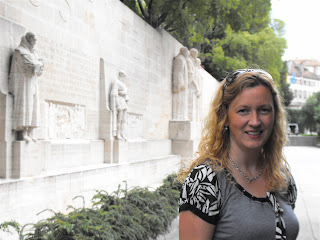
It was also a unique experience to visit the Reformation Wall in the Le parc des Bastions and to look upon the 5 m-tall statues of Calvinism's 4 main proponents: Theodore Beza (1519 – 1605), John Calvin (1509 – 1564), William Farel (1489 – 1565) and John Knox (c.1513 – 1572).
We also visited the International Museum of the Reformation and the special exhibition they are hosting entitled, A day in the life of John Calvin.
It's not cheap to stay in Geneva, so we took the cheapest option, a tent in a nearby-campsite! An added bonus was the free travel passes that every guest staying in the City receives. This gives free use of buses, boats, trains and trams, so we were able to get around the city without the hassle of driving and looking for a parking space.
Subscribe to:
Posts (Atom)


